Our news
30
06
2026
Why and how we took a bet on Ask, Contexte’s homegrown AI assistant

by
Samuel Azoulay

by
by
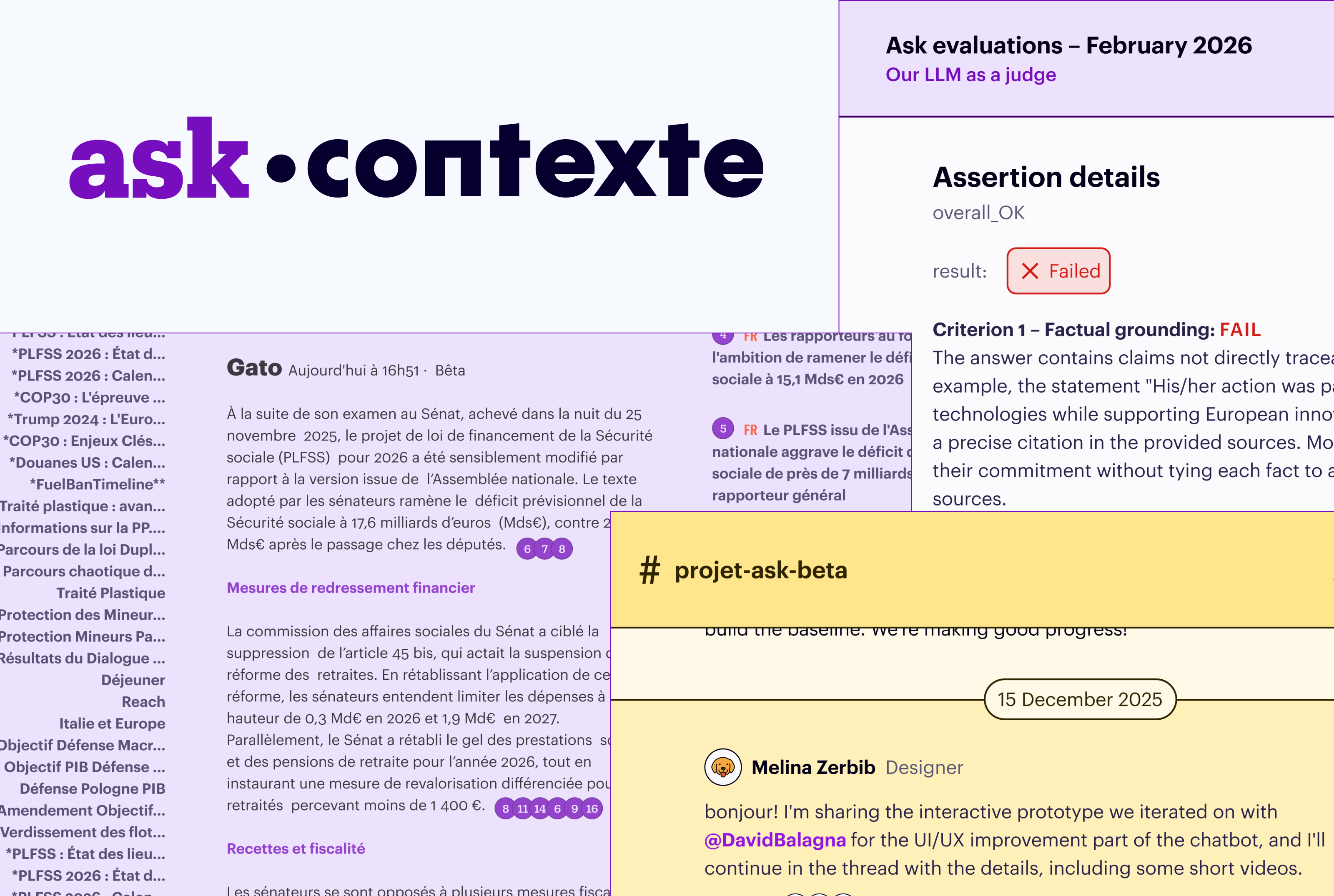
In early June 2026, we launched Ask, Contexte's conversational AI assistant, in beta. Like the general-purpose chatbots (ChatGPT, Claude, Gemini and others), this assistant answers users' queries — in our case, those of our subscribers: public affairs professionals. To do so, it draws exclusively on the editorial content produced by our 60 journalists and the official data sources we aggregate to power our features.
Rather than a standard announcement post, I wanted to take you behind the scenes of how Ask came to be. Behind the tool there is a small, tight-knit team, months of trial and error (and tests that were more or less conclusive), and, above all, a firm stance: to build the core of the project ourselves. In short, a collective adventure. So I sat down with two of the people who brought Ask to life — Clovis Picard, chief product and technology officer, and David Balagna, product lead — to talk about why and how the tool came to be, their convictions, doubts and what it means for a company like Contexte to tame AI.
For the time being, Ask is only available in French for subscribers to our FR edition. It will soon be available in English for subscribers to our EU edition.
Vous préférez lire ce contenu en français? Cliquez ici.
The rationale
Samuel Azoulay (brand strategist): To start, in a few words: what is Ask?
David Balagna (product lead): It's Contexte's conversational assistant, powered by AI and aimed at public affairs professionals. It answers their questions, drawing solely on what we produce: our journalistic content and the legislative and parliamentary data we aggregate. It’s a deliberately bounded assistant, with controlled sources and a reliable framework.
Clovis Picard (chief product and technology officer): I'd add that, above all, it’s Contexte's first AI project — a pilot, in the true sense of the word. It lets us lay the essential building blocks of the infrastructure on which we'll be able to enrich the entire experience — for our subscribers, but also for our journalists. And it allows us not only to learn to master this technology, but also understand how our subscribers want to make it their own.
Where did the idea come from? Can you walk me through how the tool came to be?
Clovis: In late 2023 and early 2024, within the tech team, we were seeing RAGs cropping up all over the place — still rudimentary systems that add a search layer on top of a language model, the famous LLMs behind the success of conversational AI. Before answering a query, a RAG searches a document base for the relevant documents and passes them to the model so it can give a more relevant answer, with that context in mind.
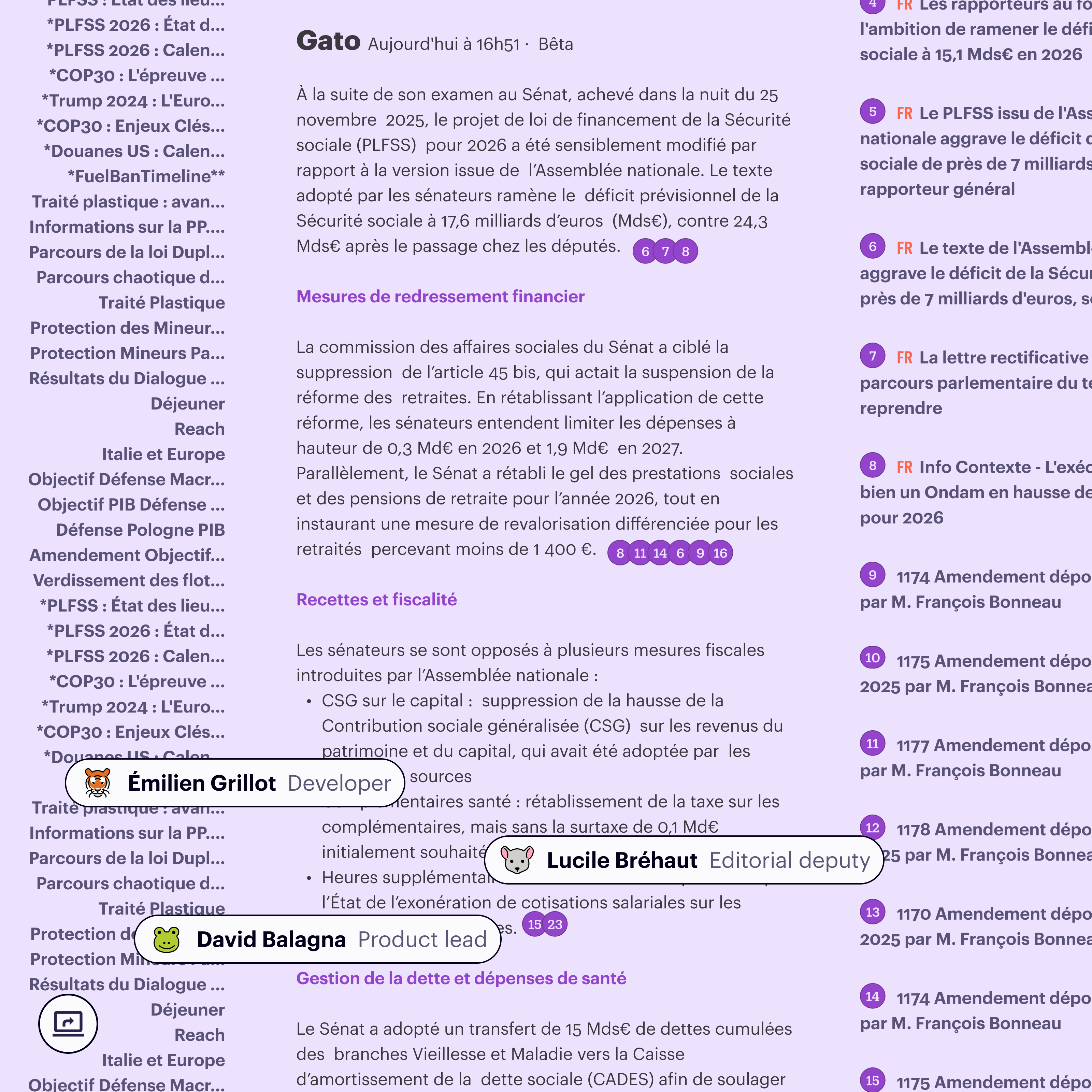
I've been working in innovation for fifteen years, and I've seen plenty of trends come and go that were supposed to change everything. At first, the watchword was “caution”. But by playing with the technology, I became convinced that this wasn't just a fad, and that it touched on the very material we work with: text. At the time, we didn't yet have a clear product opportunity, but the idea was there. We told ourselves that quite clearly something was happening and that we couldn’t miss the boat. Émilien Grillot, who was working with us at the time as a developer and who held a master's in data science and AI, was keeping a close eye on the subject. I negotiated a bit of time within a product development cycle to launch a very simple proof of concept (POC): we pitched the project — codenamed “Gato” — in March 2024. Émilien kept that thread alive for months.
So how did you go from a rudimentary POC to a tool that's now live on our platform?
David: Ask started as a technical bet that we then sought to turn into a product opportunity. But at the outset there was no product roadmap, no commercial pressure, nothing. The whole point was to make it a genuinely useful feature — not necessarily a perfect one — and a pilot project: the first stone in a broader vision of what Contexte could become in the years ahead. It's also worth stressing that we're a B2B media company with a high average revenue per user. That's what allowed us to bank on this beta version, and then to consider commercialising and monetising such a product more easily.
Clovis: There was also a public test with around ten users, in 2025, which gave us valuable insights. At first, we'd only connected the editorial database. But users immediately said: 'No — we want access to all of Contexte's data, including the legislative data.' That did a lot to shape what came next. And it coincided with the moment I was taking over as head of product, when we were seeing peers such as Politico making moves in this area… We had a POC that worked: we had to release it.
David: The real momentum came in late 2025. We had an alpha version that showed a lot of promise, but also limitations. And, thanks to that pilot, we already had a wealth of internal feedback to draw on: the newsroom took hold of it, with enthusiasm, but there was also some criticism and pushback. From then on, the question became: how do we move from an internal test to a product? That's first and foremost about conviction — forging it, then sharing it.
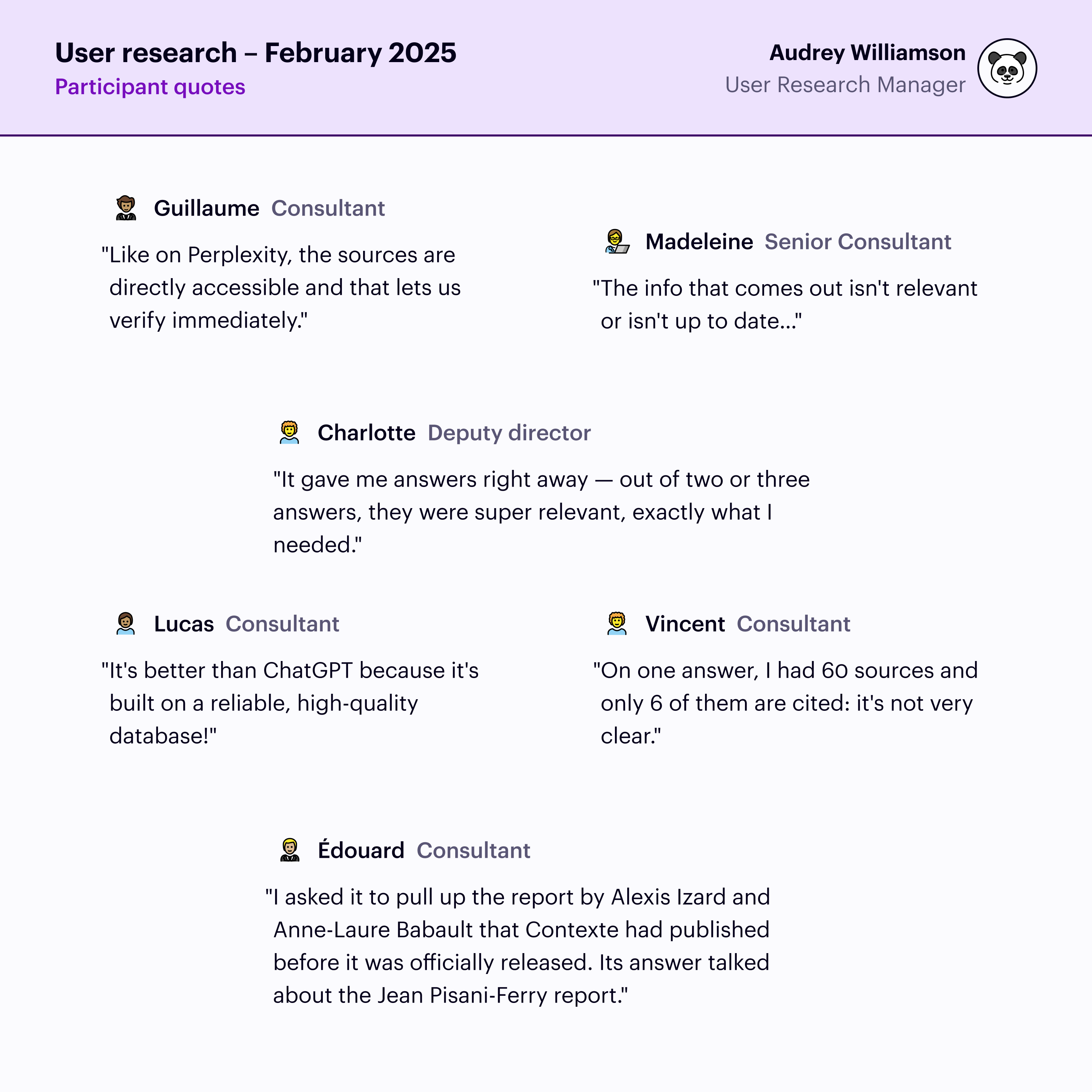
Looking at what our subscribers were already doing also fed our conviction. Audrey Williamson, User Research Manager, ran a study. One key finding was that our users were already making heavy use of general-purpose LLMs (ChatGPT, Gemini, Claude and others), including with Contexte content. One frequent ChatGPT user who tracks legislative dossiers had a telling habit: going back to Contexte to check the accuracy of what the tool was giving him. So the value already existed — but elsewhere. The point was to bring it back home, into an experience we control.
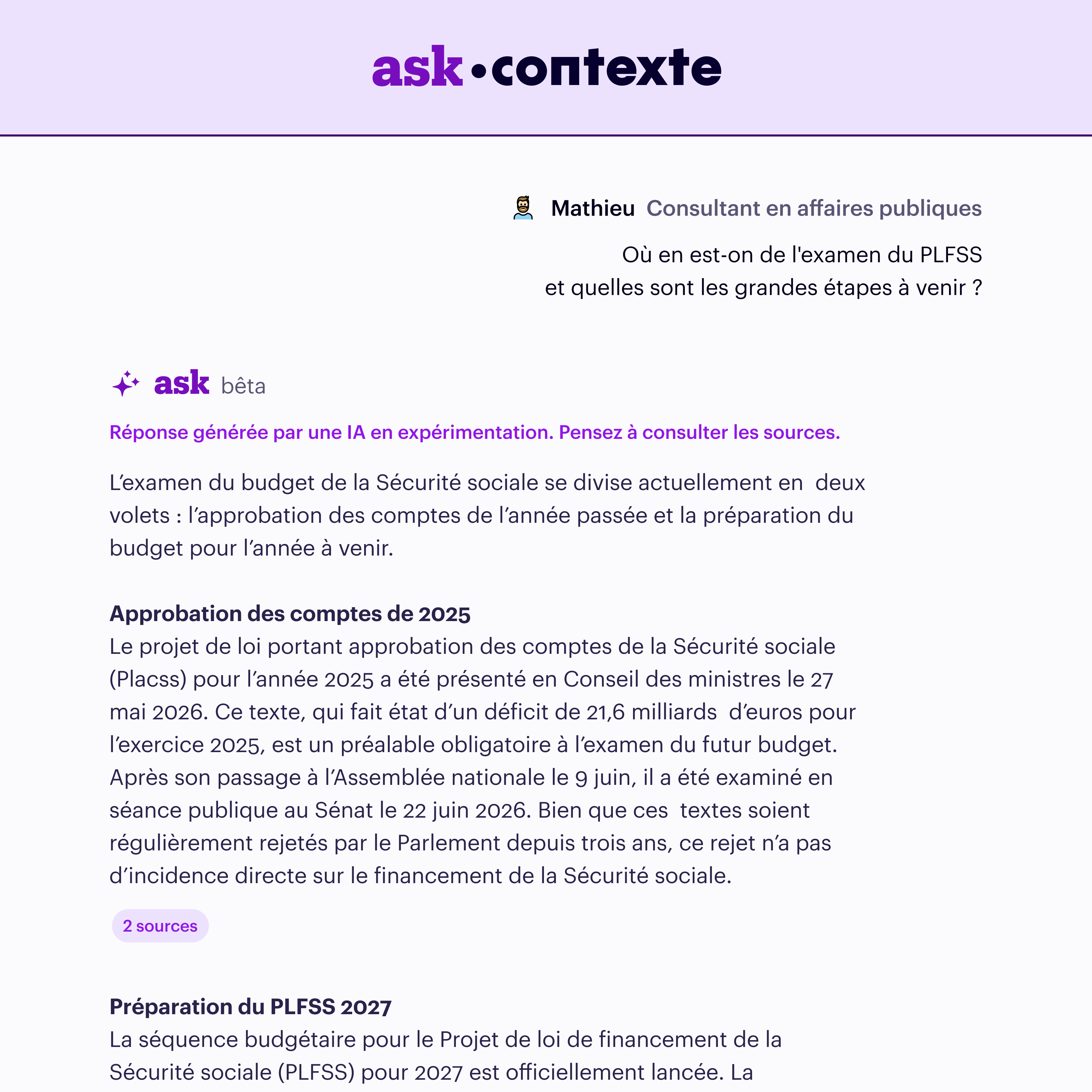
Analysing queries from the public test also brought out recurring use cases. The first is something we call the “state of play”: on a long-running dossier, it refers to the need to step out of the daily flow and ask “where do things stand?”. For example: “Where do things stand on the EDF privatisation bill?” It's a natural question, and it's typically where Ask really proves its worth for our subscribers.
The homegrown option
All these signals and all this qualitative data must have helped make Ask a priority, though there must also have been some internal reservations. How were those overcome, and are there still any?
Clovis: Honestly, I don't think they've all been overcome — and that's healthy. There's a cultural point first of all: Ask runs counter to a conventional product approach. Usually, you identify a use case and look for the best possible answer. Here, it's an open interface, a text field where the user can ask anything, and over which we don't have 100% control of what comes out. In a company with a strong product culture and exacting journalistic standards — reliability and control over content — that's a real challenge. There were also the societal and environmental issues associated with LLMs. Two years ago, releasing such a tool was by no means a given for everyone. Today it is more so, virtually everyone uses AI chatbots every day.
David: What changed minds, I think, was talking to users — realising that Ask is complementary, and that nothing will replace the value of content like our briefing, sent at 8am, backed by exacting journalistic standards, giving you the essentials you need to know about your sector at a given moment. That's our flagship product. Ask is a tool for doing everything else, starting from our content — and even enriching it.
Following that logic, beyond the strategic choice to build on our own content, the bold stance, it seems, was the decision to build Ask ourselves. Why was that crucial?
Clovis: Because it's a technology that's evolving at a dizzying pace, and one where you have no certainty about how it will be used. If you don't build the knowledge in-house to develop it, adapt it and reuse elsewhere what you've integrated, you haven’t built anything. You've pulled off a marketing stunt, but strategically it's got you nowhere: at the slightest new need, you start again from scratch or you're entirely dependent on an outside provider. At the time, we were seeing other media outlets outsource everything. For us, bringing it in-house was almost a given. And today, it's just as well we did: what's most valuable to us is our knowledge of the technologies, our command of the infrastructure and the ability to keep it evolving.
David: There are two things I love about this choice. The first is human: upskilling our product, design and tech teams. To really master a technology, you have to get your hands dirty, get into its complexities. It's an expertise we only partly outsourced — with two expert freelance engineers at key moments — and it means that today, the team we have in place can see further ahead.
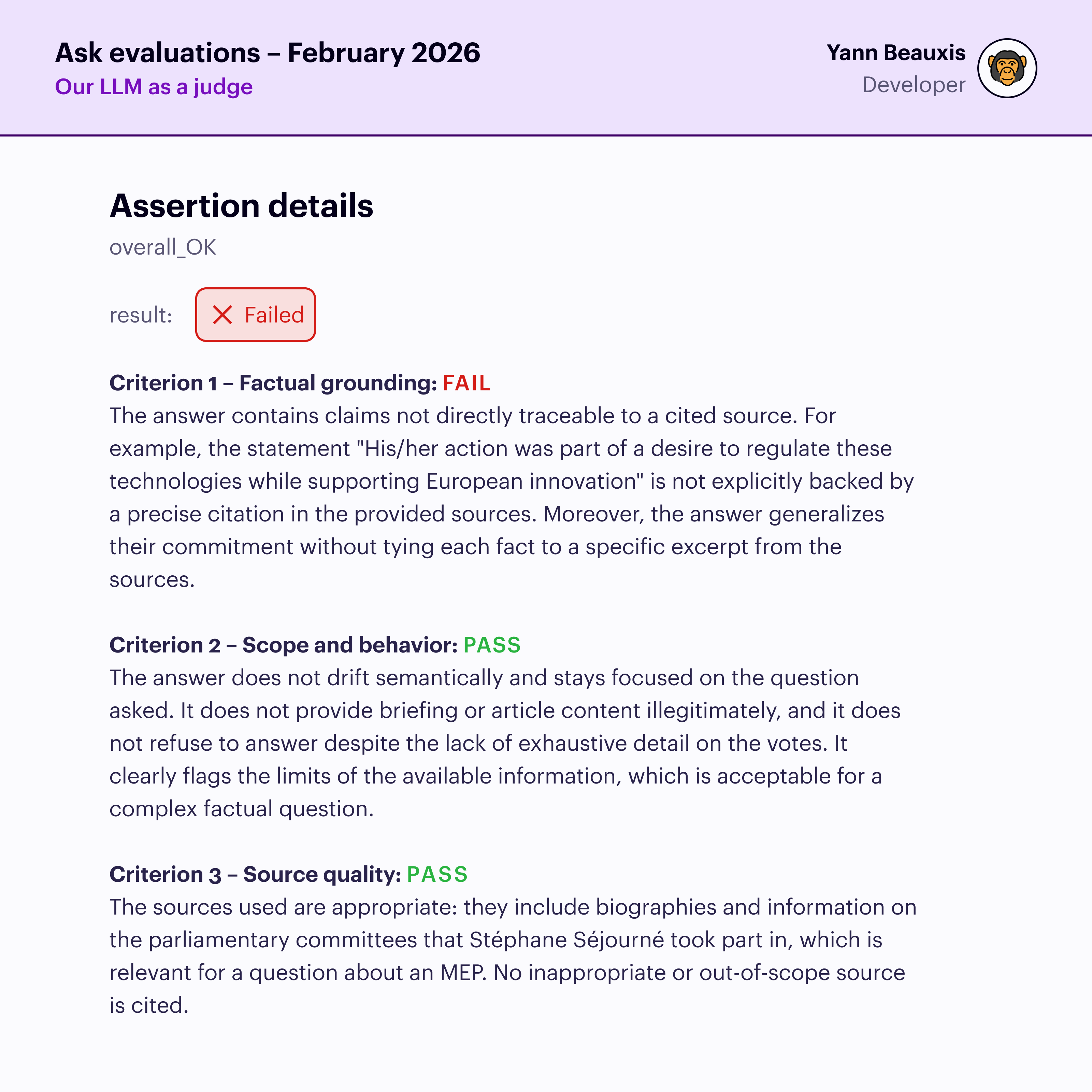
The second is trust. Mastering our infrastructure (rather than the models — we'll come back to that) is what allowed us, collectively, to gain confidence. It's what lets us rein Ask in very precisely: telling it to stay in its lane, not to answer a question that's outside its remit, not to give an opinion or to be honest when it doesn't have the source. And it's what gave us a real ability to evaluate the answers. We also brought a journalist from the newsroom, Guénaël Pépin, into the methodology. He evaluated a set of key questions with a journalist's eye — rigorous and demanding — and we turned his feedback into an automated evaluator, what we call an “LLM as a judge”, which lets us measure answer quality at scale.
In terms of mastering our infrastructure, and without going into excess technical detail (this will be covered in a blog post by one of our developers), what does Ask rely on, and what is really “ours”?
Clovis: Let's be transparent from the outset: we didn't train a model. The best language models on the market aren't open source and, in any case, that's not where the value lies. We use existing models, via application programme interfaces (APIs). What we've built around them is entirely ours. The whole infrastructure and the workflow. In concrete terms, when you ask a question, it isn't simply “sent” to a model. A first step works out what kind of question it is, which triggers a specific path, fetches the right information from our sources and builds the answer. There's a whole architectural complexity hidden behind a deceptively simple interface — and that's what we develop ourselves. The toolkit we use for it is open source, and we're model-agnostic, which leaves us free to test and make our own choices.
David: That's exactly the point. Being model-agnostic means we can experiment. Today, in production, we rely mainly on a Gemini model and a Mistral model, and we're testing others, including Claude. But the value, and the differentiation, lies in the verticalisation on public affairs and everything we've built around it. Yann Beauxis, the developer who led much of these technical and design choices, will come back to this in a dedicated post soon.
Since we have almost end-to-end command of the technology, I imagine it's also “easier” to manage the risks inherent in AI assistants. What safeguards have you put in place to limit them?
David: There are several issues here. On reliability: we can't eliminate every risk of hallucination, but we minimise it dramatically. And above all, when the sources aren't there, we own that and even encourage Ask to say it doesn't know rather than over-interpreting. It's also a way of earning users' trust, being transparent about the limits of a product that's still in beta.
On usage, we have technical safeguards against misuse. Finally, on the privacy front — a topic that came up rather late in the roadmap, but one we decided to tackle head-on, with our lawyers — we've put a first building block in place: the user gives clear consent before using Ask. And, because we're a journalistic company, we maintain a watertight separation. A journalist obviously can't look at a user's query history. We'll go much further — encryption, anonymisation — once we're out of beta.
A collective adventure — and one that continues!
Beyond the external resources brought in on an ad hoc basis, such as the lawyers, you mentioned the work of Yann, one of our developers, as well as bringing Guénaël, a journalist from the newsroom, into the project team. But today, in practical terms, who makes up the team behind Ask?
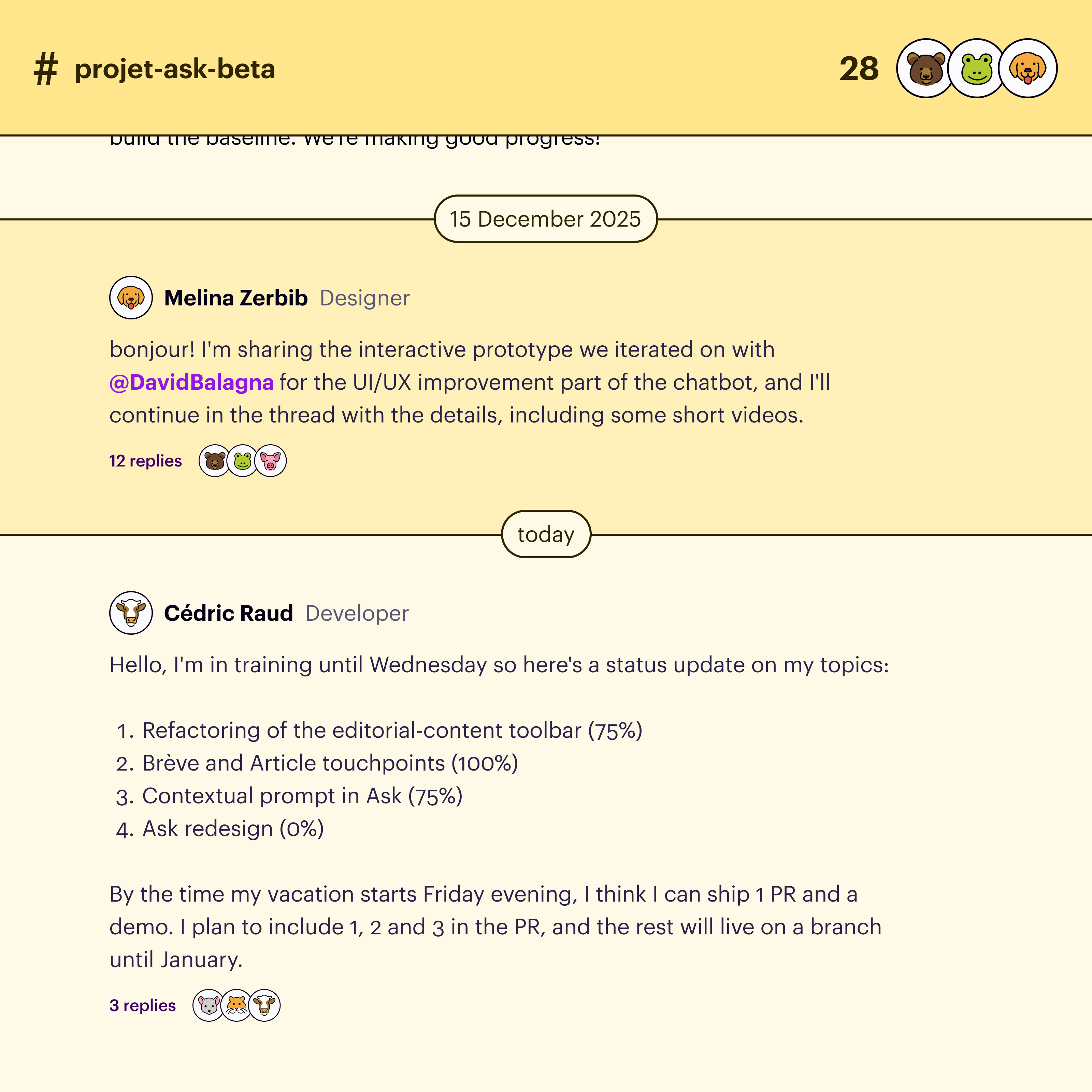
David: An autonomous team, organised as a squad, like all our product development: a tech lead (Yann), a product lead (myself), a design lead (Melina Zerbib) and developers around them. It has changed a great deal — sometimes very lean, sometimes broader. As I said earlier, we also brought in two freelance engineers, who had experience with this kind of project and who helped us move from a prototype to a production tool. They were integrated as members of the team, present at cycle kick-offs, in all the rituals... Other areas of expertise also came on board: Naïma Mauchauffée, on the product marketing side, who took over shaping the go-to-market strategy; Guénaël, on the editorial side, a key point of contact, who now devotes part of his time to major product initiatives and the newsroom's AI workflows; and Clovis, in a cross-cutting role, who championed the project within Contexte's executive committee. All this without ever committing 100% of the tech-and-product team. Ask moved forward alongside other initiatives, because it remains an option with a limited “appetite”.
Do you think we'll continue to depend partly on external resources, human and technical?
Clovis: Bringing in one or two freelancers who work day to day with the team on our codebase isn't the same as handing a project over to an outside team. By joining the team, one of the two engineers brought us skills we didn't have. His engagement with us ends in late June 2026, and our goal between now and then is crystal clear: the day he steps away, we'll have taken full ownership of everything he's done. Every line of code is ours. That doesn't mean we'll never call on outside expertise again, but we retain complete control of the knowledge and the code in-house.
We're also often asked about sovereignty. It's an important subject, but it isn't our top priority. And, as things stand, we aren't sovereign, since we go through APIs hosted in the United States. For now, we are looking to master the technology.
David: There's a real “build” culture at Contexte, and a culture of mastery — not out of dogma, but because that's what makes us autonomous going forward and strengthens our independence. Echo, our bespoke collaborative editing tool for our journalists, is another telling example.
Looking ahead, what's left to improve in the short term? And what's the medium- to long-term vision for Ask?
David: In the short term, consolidating our move out of beta by the end of 2026, with technical work, work on the experience and adding sources. We don't yet cover 100% of our scope — Brussels in particular, which accounts for a large part of our market.
Then there's the real question behind any launch: what counts as success? The temptation is to look only at volume. In launch week, we had more than 1,400 messages, which is a lot at our scale, in B2B, with a small target audience. But we're trying to achieve repeat engagement: a cohort of users who come back of their own accord, with recurring use cases. That's what we're watching in order to steer what comes next. In fact, we're already seeing more “agentic” uses take shape, around recurring tasks and actions, and far more cross-cutting, not just on content (creating keyword alerts, reminders and so on). It’s essentially an “open-air” laboratory for learning how our product will evolve.
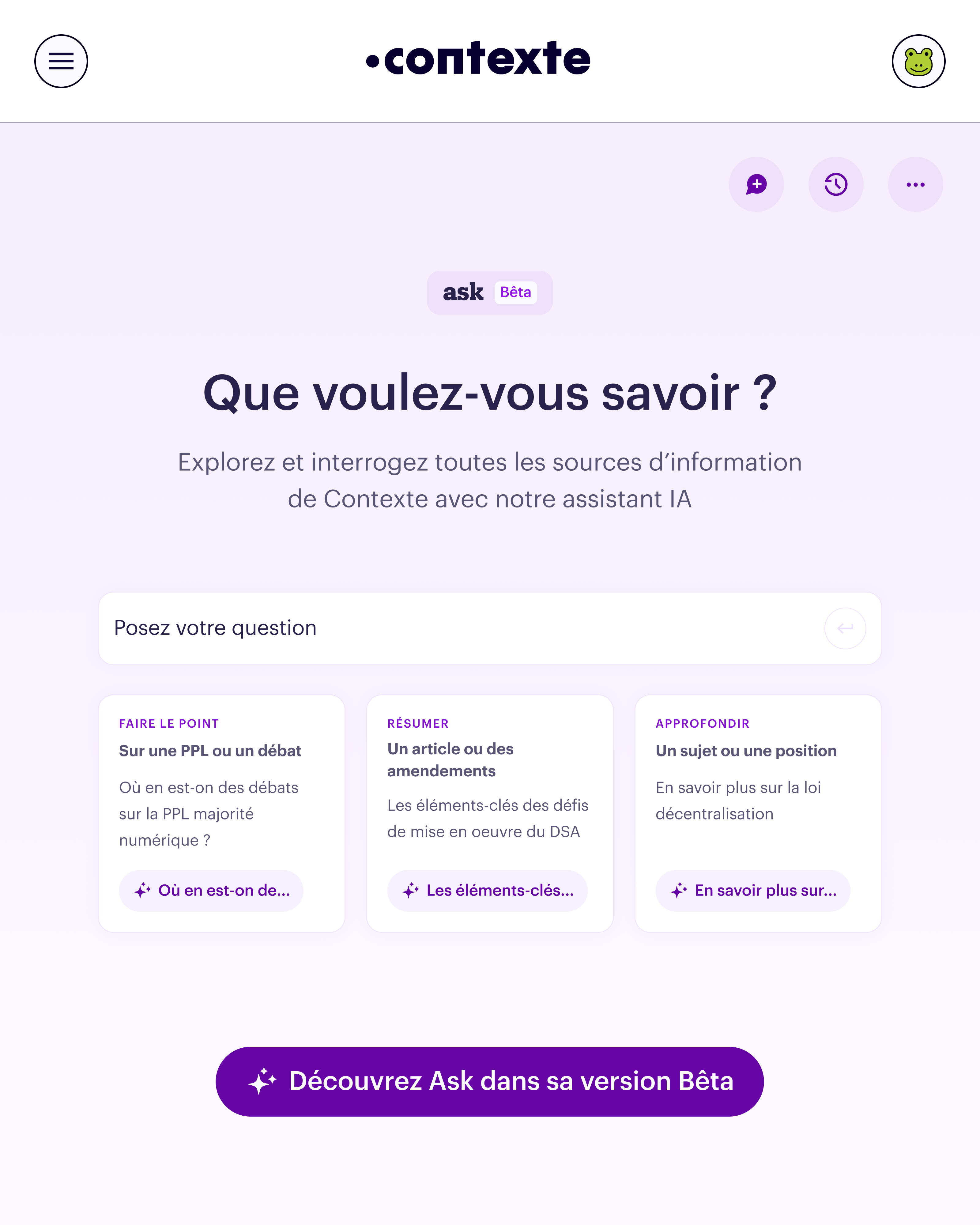
Clovis: I'd sum up the vision in a few words: that Ask becomes a single gateway to a cross-cutting Contexte experience. That a subscriber can do everything from the interface — consult and summarise content, but also take action: configure their account, create keyword alerts or set up advanced legislative tracking. We'll create the most value in the future in the data. Faced with a general-purpose LLM that draws on the raw data of the web, we offer a considered, deeply domain-specific structure that we can pass on to the model — notably on French and European legislative data. Combined with our editorial expertise, that can make Ask the go-to tool for exploring political data.
David: At its heart, it's a genuine building block of political intelligence. Our subscribers' instinct, from the very beginning, has been to make the connection between the public data they consult and the journalistic content. Ask is extremely good at that.
Clovis: I'll finish by saying that we have to be clear-eyed: perhaps we'll find that it isn't the right interface, not the right path. In the end, we don't know.
David: But, come what may, we had to go through it to find out.
--
To find out more about Ask’s features and try it for free, visit our website.
All visuals by Adèle Orain, art director at Contexte.
,
MORE NEWS